
Let's begin with the classic technique of throwing out a bunch of scary statistics to build importance and establish credibility. (Just to get it out of the way before getting into V2V communication and why it matters.)
There are...
1.3 million worldwide deaths, per year, from police-reported car crashes (3,287 per day).
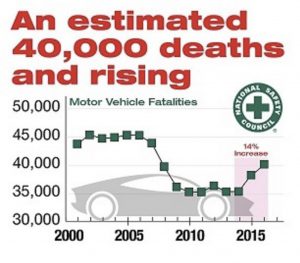
37,000 – 40,000+ American car-crash-related deaths per year.
$230.6 billion spent per year in the U.S. to deal with car crashes.
Due to the distribution of crashes across the nation, and the ways these numbers trickle in a few each day, most of us remain unaware and unaffected by the growing problem. And yet, these fatalities are a hefty burden we pay to enjoy our beloved machines. While deaths per 100 million miles driven are down, which is important, the overall body count has been rising significantly since 2015.
Sure, we can talk all day about distracted driving and why you shouldn't text and drive, but distracted driving and inappropriately timed texting has been around well before 2015. Is there anyone—or anything—that can help us out? If only there were some way for our cars to "talk" to each other from hundreds of feet away and alert drivers to potential hazards before they're even in sight. Hmm...
What is Vehicle-to-Vehicle communication? Alright, we made it through the numbers part. Let's step away from shocking car crash statistics and take a close look at V2V (vehicle-to-vehicle) communication and its implications for car culture and driver safety. V2V technology allows vehicles of all makes and models to communicate on a 5.9 GHz spectrum, as permitted by the Federal Communications Commission (FCC). That means every manufacturer has to "play nice" with the competition in order to make this work. And so far, it looks like that's just the case.

Is there a downside to V2V communication? The argument against V2V technology isn't that the cars will become "aware" and throw their fleshy masters out the window while traveling at high speeds (sounds like Michael Bay's next bad movie). It's that the cost increase it puts on a new vehicle isn't worth the benefit, or it stretches the price point too far. Some fear the tech could be replaced by something else, making V2V a waste of an investment today.
Another anti-V2V argument is that the tech is not-so-great for car culture. Most driveway mechanics like cars that are simple, easy and inexpensive to maintain and repair. These folks can't service these systems, and when the electronic components inevitably need servicing down the road, the costs are unlikely to be anyone's definition of "cheap." Furthermore, traditionalists may simply fear that relying on a computer to alert you to pedestrians or upcoming road hazards may encourage mental laziness that results in avoidable accidents.
The bottom line about V2V Let's be honest. "Regular" cars aren't going away, and autonomous driving isn't going to fully replace "regular" driving in our lifetimes. If you want an inexpensive vehicle that's easy to maintain, you'll still be able to find one in 10 or 20 years. But even if V2V, and later, autonomous driving were to take over, the bottom line is that all this new tech is guaranteed to save lives. If going the speed limit is one supercar lover's form of eternal damnation, there are 40,000 American lives lost this year due to automotive incidents; that's far more compelling than the speed demon's fear of losing his way of life. (Some might disagree with this statement, but that's why we keep a comments section below.)
Undoubtedly, Vehicle-to-Vehicle communication has unlimited potential to be the life-saver and difference-maker we deserve.